Back

2-Spirit Bookshelf

Sho
Get a Rec

2-Spirit Bookshelf

(@Indigenousbookshelf)

Books for badasses! (or Stories rooted in kinship- for something a little less abrasive)🌱🌈 🍓🌊🌑🦦✨🪶📚

Books for Badasses

Indigiqueer reads🪶🌈

Back

2-Spirit Bookshelf

Sho

2-Spirit Bookshelf

(@Indigenousbookshelf)

Get a Rec

Books for badasses! (or Stories rooted in kinship- for something a little less abrasive)🌱🌈 🍓🌊🌑🦦✨🪶📚

Books for Badasses

Indigiqueer reads🪶🌈

 Feed

 Bookshelf

 Membership


New reads and brb


6 titles featured

book coverbook coverbook coverbook coverbook cover

Jan 13

Global Indigenous Book Challenge ~ stories at the intersections 🤝

Global Indigenous Book Challenge ~ stories at the intersections 🤝 swipe for who I include when I say Indigenous 🫂 Link in bio for StoryGraph challenge! Fok not-so-Goodreads ehh Last year I forgot to post the challenge I made so I might post that one later too?? Idk that’s a lotta readin’!! Disclaimer: I am fully aware how obnoxious the cover of this post is and I am sorry


Jan 10

image

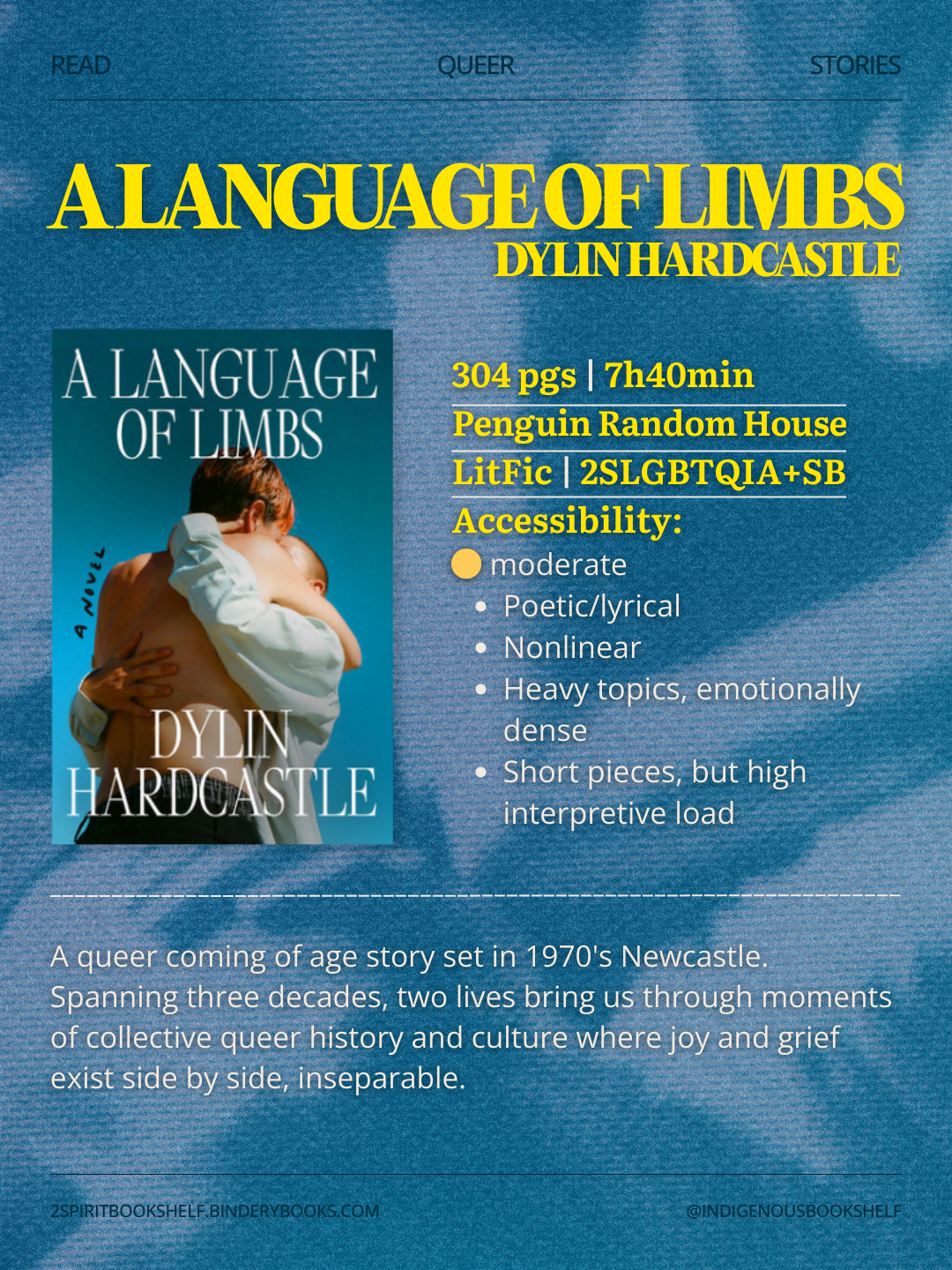
Thanks no thanks to Dylin Hardcastle for bulldozing their limb through my gut, tearing out my heart and throwing it into a wood chipper

Dylin wrote A Language of Limbs as part of their PhD and it is their debut novel. (How they are ever going to top this - I have no idea!!)

The story is set in 1970’s Newcastle, following two queer youth referred to as Limb One and Limb Two. Spanning three decades, these two lives bring us through moments of collective queer history and culture where joy and grief exist side by side, inseparable. (Australia’s first Mardi Gras, the AIDS crisis, etc)

A Language of Limbs is a collection of lives stitched together with poetry, art, fragments, and feelings. The seemingly little moments carry enormous weight, reminding us how terrifyingly close we always are to a completely different life. The book is about love being policed, friendship as love, queerness lived loudly & quietly, and everything in between. It’s so dang heartbreakingly tragic, and yet sooo deeply hopeful. I cried and cried and cried.

This is an essential queer read. It is going to stick with me for a long, long time. The AIDS epidemic section had me fucking winded, gasping for air and sobbing (literally!!)

Shoutout to the author for their recognition and appreciation of Indigenous peoples, as well as the impact Indigenous liberation movements have had on queer ones. That was super cool of them to acknowledge and I am very grateful for it.

I will (and already have started) gifting this book to everyone I know.

I can’t wait to read more from Dylin!!

————————————

“Let me tell you / my dead friends were so much fun / let me tell you / we had so much fun / let me tell you / it was worth it.”

“I am most free when I am in connection, because I know my liberation is bound up with yours,"

“Grief is not sadness. Grief is the body cut open. Flows of blood and joy and salt and ache and words and memories and memories never made. Grief is undoing. Grief is wanting flesh, yearning for a voice. Grief is fear of forgetting...a face...the contour of a hip...your brilliant red hair...Grief is wondering what could have been made and what could have become. Grief is what if. Grief is endless cycles of why, and I wish I didn't. Grief is the guilt of the living, of my living. Grief is the sobbing into my birthday cake, because I'm older than you, now. Grief is the building of a world without you in it.

Then there’s the less obvious, the part no one writes about. How grief is horny. How I bend myself over the bed head and feel your fingers in my ass, real and imagined. Fried is pining for your touch. Grief is being wet for a ghost. Grief is not sadness, it is a kaleidoscope of desires like white lights refracted through skin. Sadness, it think, is the object. And grief is the negative space.”

“Queering. Queer, as in adjective, as in being, as in I am this. Queer, as in verb, as in doing. As in I queer this. Queer, as in fucking queers. Queer, as in I queer’d this, as in, I made it beautiful.

"Once, you hear a lesbian say I don t believe in transsexuals. And Daphne cries heaven forbid I believe in myself. I believe myself." 

“Against the impossibility of it all, joy persists. [...] I think, look at us. Witness us. In a world that wishes for our annihilation, here are our bodies, spectacularly colliding. [...] Look at our family. Look at our joy, our glorious, glorious joy”

“it is difficult for a woman to define her feelings in a language chiefly made by men to express theirs.”

A language of limbs review ✨


1 title featured

book cover
G I V E A W A Y : By the Fire We Carry- Rebecca Nagle

G I V E A W A Y : By the Fire We Carry- Rebecca Nagle If you haven’t been paying attention this is one of my new fav nonfiction +1000⭐️ To enter: Become a member of my Badass Besties @ 2spiritbookshelf.binderybooks.com Like my this post on there *Alternative entry: share this to your story and 3 friends!* Winner announced on Xmas! Happy Holidays Comrades!!!🍓🤝


1 title featured

book cover
2026 Global Indigenous Books

Indigenous authors saw the 2025 Goodreads nominations and said, “Hold my bepsi.” Every year is a whole ass scavenger hunt to find enough titles for this list but for the first time ever I can say there is overflowing abundance of Indigenous books on the horizon!!!!. 🍓🌈🌻📚 And this is only part 1. ⁉️ tell me what your Indigenous reading goal is for 2026!!!!! ‼️


14 titles featured

book coverbook coverbook coverbook coverbook cover
Where it all began!
Where it all began!

Indigenous bookstagram tour! I haven’t gone to bed yet so it’s technically still my day right? 🙃 Here are the books that started this account, the books I am reading now, and the ones I hope to start soon!! What are y’all reading for Native American heritage month???? Who is reading Indigenous all year long?????? Check out my bindery for more bookish things 2spiritbookshelf.binderybooks.com 😊


25 titles featured

book coverbook coverbook coverbook coverbook cover

image

BLEAK.

And tbh not as radical as I was expecting.

I went in completely blind re: the plot, but had heard this was politically poignant. And honestly, I have very mixed feelings.

The writing is undeniably skillful. It’s minimalist, emotional, and existential. The author builds this overwhelming despair without using violence or spectacle. It’s just an entire atmosphere of emptiness - little plot, no action, yet totally fuckin soul crushing. IMO it puts The Handmaid’s Tale to shame. I who Have Never Known Men achieves a deeper horror and sadness through quietness alone. Nothing is resolved or explained, and it still feels whole.

But the more I sit with this book, the more uneasy I feel towards its messaging.

It’s very clear that Jacqueline Harpman was writing from a Jewish perspective. There’s this recurring idea that the guards are also prisoners, trapped in the same invisible system. On first read, it felt like commentary on how power structures replicate themselves, how people end up enforcing the very systems that crush them. But upon reflecting, the framing seems more like absolution than critique. A cop out?? Everyone’s trapped, so no one’s really responsible. And in thinking about the world’s current events I can’t help but wonder if Harpman would extend that same empathy to Israeli soldiers, to colonizers?

Something I didn’t love was the stance on ownership. The narrator never had property, never been taught about possession, but the second she finds stuff it’s hers. She finds a bunker, arranges it, and claims it. And it’s treated as human nature instead of learned colonial violence.

Another thing that cheesed me was the topic of sexuality. As a queer ace person I found it weird that the narrator is immediately attracted to the one young man despite having literally zero exposure to romance, attraction, or gender roles. She’s literally never known men. Her puberty happened in captivity and her development was completely fucked by trauma but there’s still this automatic heterosexuality with no questioning/ ambiguity. Just the default setting. Why?

And lastly, there’s the book’s engagement with death, dignity, and assisted dying. It’s rare to see those topics handled with such acceptance and pragmatism as in this novel.  I respected that the narrator could help people die when they asked. BUT then she refuses to help the one woman who isn’t physically ill????? The narrator has no religion or inherited morals so where’s that line coming from? It seems like the author’s own unspoken values.

SO the more I think about it the more this book feels like a missed opportunity. It’s packaged as radicalism, but sorta reinforces the status quo. But maybe that there is the point after all ????

“What does it mean to have lived, once you’re no longer alive?”

Super Unpopular I Who Have Never Known Men Review😳 (sorry y’all!)


1 title featured

book cover